
Many companies have knowledge, but it is often not available where it is needed. aim – the Academy for Innovative Education and Management in Heilbronn-Franken – faced exactly this challenge. Together with XEPTUM, HeinzAI, and our partner incontext.technology, we developed a solution that brings together knowledge from documents, processes, and employees’ experiential knowledge on a central platform. The result: knowledge is permanently preserved, made available more quickly, and actively utilized in day-to-day work.
Why does knowledge management so often fail in everyday practice, despite good intentions?
Knowledge is usually not lacking; rather, it is scattered, unstructured, or unavailable at the crucial moment.
Many organizations possess a vast amount of knowledge. Nevertheless, day-to-day work regularly involves follow-up questions, duplicate efforts, and time-consuming search processes. Information is scattered across various documents, systems, and filing systems, while a large portion of critical knowledge resides exclusively in the minds of experienced employees. This was precisely the situation aim found itself in. Valuable knowledge was available, but it could not always be accessed quickly and effectively. At the same time, there was a risk that experiential knowledge would be lost when employees left the company.
The key insight here: The problem often lies not in a lack of knowledge, but in its lack of structure, interconnectivity, and accessibility.
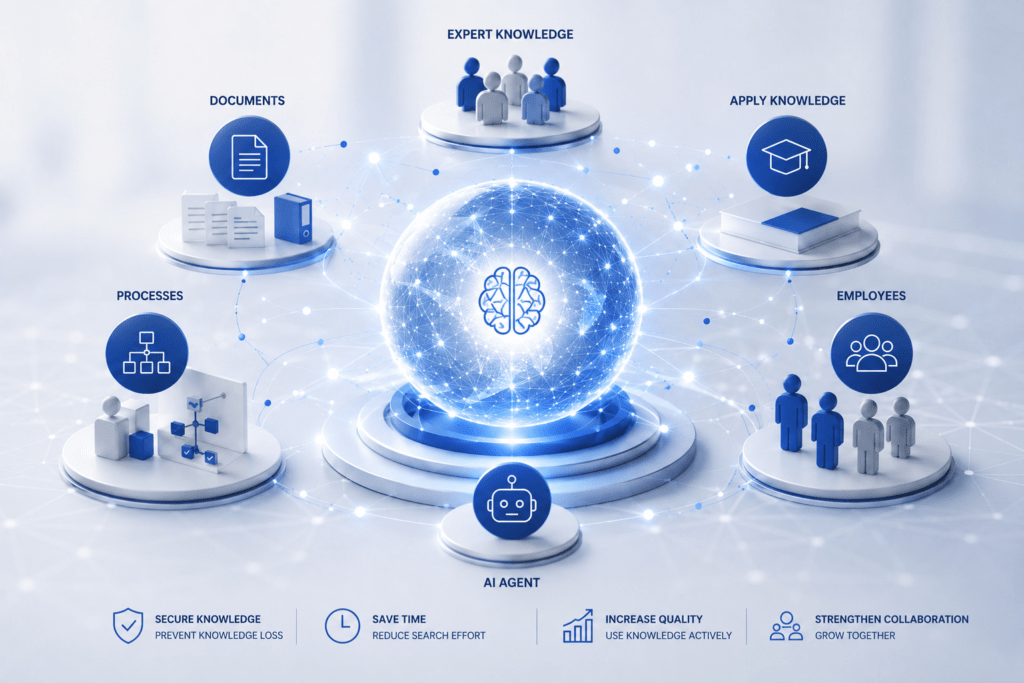
AI-based knowledge management integrates documents, processes, experiential knowledge, and employees into a central knowledge base that preserves knowledge over the long term and makes it accessible for everyday work.
Why isn’t digitalization alone enough?
Digitalization doesn’t improve poor processes; it merely digitizes them.
Many companies initially respond to knowledge-related problems by introducing new tools or digitizing existing content. However, technology alone does not solve the underlying challenges. aim therefore made a conscious decision to first analyze and optimize existing processes before introducing new technologies. Only on this basis could AI realize its full potential.
As Managing Director Marco Haaf aptly puts it:
“If you have poor processes, digitization will ultimately only result in poor digitized processes. At aim, we had a different goal: Working together with XEPTUM and HeinzAI’s solutions, we – as Client 1 – first fundamentally optimized our processes and then used AI to make them future-proof.”
This approach shows that technology is not the starting point for successful transformation, but rather its catalyst.
aim’s experience shows that a successful digital transformation strategy takes processes, people, and technologies into account in equal measure.
What were aim’s goals in implementing AI-based knowledge management?
The goal was to create a central knowledge base that preserves knowledge, supports employees, and grows alongside the organization over the long term.
The focus was on how to permanently preserve existing knowledge while making it accessible to all employees. This involved not only documents and process descriptions, but especially the organization’s experiential knowledge.
In addition to reducing the time spent searching for information, knowledge should be actively utilized to support decision-making and operational tasks. At the same time, it was important to create a solution that would be accepted in the long term and could be flexibly adapted to new requirements.
Successful AI-based knowledge management lays the foundation for making knowledge available throughout the organization, preventing knowledge loss, and providing targeted support to employees in their day-to-day work.
How can AI-based knowledge management be successfully implemented?
A successful implementation is achieved through small steps that deliver measurable added value.
The project began with a clearly defined proof of concept. This made it possible to assess early on what actual benefits the solution offered in day-to-day work and how employees were adopting the new platform. Based on these findings, the solution was continuously refined using real-world use cases. This practical approach enabled rapid learning and ensured that the platform could be consistently adapted to the organization’s actual needs.
Why are employees crucial to the success of an AI project?
Sustainable transformation can only succeed if people are actively involved.
A key factor in the project’s success was the early involvement of selected key users from the business units. Not only did they contribute their expertise, but they also actively supported the effort to establish the new solution within the organization. This fostered trust in the platform and, at the same time, created a shared change process. The rollout was not viewed as a technical project, but rather as an organization-wide evolution of how work is done. Especially when it comes to topics such as AI-based knowledge management or a comprehensive digital transformation strategy, it becomes clear time and again that technology, processes, and people must be considered together.
What role does change management play in AI-based knowledge management?
Change management often determines whether a solution will be used on a long-term basis.
In parallel with the technological implementation, aim focused on training, regular feedback loops, and the ongoing involvement of employees. An iterative improvement process was particularly important in this regard. Through systematic feedback, content and features were continuously optimized. As a result, the platform did not develop in a static manner but evolved alongside the organization’s needs. The difference between a successful rollout and a sustainable transformation often lies precisely in this continuous improvement process.
What exactly was implemented using HeinzAI?
ai.me is an agent-based platform for AI-driven knowledge management.
As a result, aim established ai.me, a central knowledge platform that brings together knowledge from documents, processes, and employees’ experiential knowledge. At the heart of the system is an AI-powered knowledge assistant that serves as the central interface to the organization’s knowledge. Information is no longer viewed in isolation but is linked, contextualized, and made actively usable. A key difference lies in the systematic capture of tacit knowledge. Experiential knowledge, which previously existed exclusively in individual minds, is structured and made available to the entire organization. This creates not just a knowledge database, but an intelligent knowledge space that continuously grows and evolves.
What results were achieved?
Knowledge is no longer sought out; instead, it is available exactly when it is needed.
The systematic structuring and externalization of knowledge has resulted in a quality-assured knowledge base that can be used throughout the organization. Search times are reduced, knowledge is preserved over the long term, and employees gain faster access to relevant information. At the same time, decision-making processes are supported and collaboration within the organization is improved. This transforms individual sources of information into an intelligent knowledge system that actively contributes to increased efficiency and turns knowledge into a genuine productivity factor.
Why is this project a special milestone?
Because a shared vision has led to a productive solution with measurable added value.
aim was the first client to embark on this journey together with XEPTUM and HeinzAI. We are all the more pleased to see how the platform has now become an integral part of our daily work. Special thanks also go to our partner incontext.technology, which has supported this project from the very beginning and, together with us, is proud of the successful implementation with our first client.
What can companies learn from this success story?
Successful knowledge management results from the interaction of people, processes, and AI.
The successfully implemented project at aim shows that technology alone does not bring about sustainable change. Only when knowledge is structured, processes are optimized, and employees are actively involved does true added value emerge. This is exactly where HeinzAI comes in: Knowledge is not only stored, but also interconnected, contextualized, and made usable in everyday work. As a result, knowledge evolves from a passive corporate asset into an active success factor.
Would you like to learn how AI-based knowledge management can be implemented in your company? Talk to our experts about how to turn dispersed knowledge into a centralized, intelligent knowledge base.


