

Agent-based AI no longer just answers questions. It can plan tasks, use specialized tools, consolidate information from various sources, and feed results back into business processes.
Many companies are currently experimenting with generative AI. But the real trend is already moving a step further: toward agent-based AI.
The difference is crucial: While generative AI in the form of chatbots primarily responds to individual requests, agent-based AI can independently coordinate multiple steps and integrate various systems. That is exactly where HeinzAI comes in.
Why is a chatbot often no longer enough these days?
Because the biggest challenge for companies is rarely a lack of access to AI, but rather access to the right knowledge.
Knowledge is stored in documents, emails, tickets, SAP systems, meeting minutes, or in the minds of experienced employees. At the same time, teams spend a lot of time searching for information, making connections, or re-learning knowledge that is actually already available.
HeinzAI was originally developed to address precisely this question: How can knowledge be preserved, made accessible, and put to use in day-to-day work? This gave rise to the concept of a digital enterprise twin that digitally maps knowledge, experiences, roles, and organizational structures. Rather than looking at isolated data sources, HeinzAI integrates knowledge from different systems into a shared context.
What does agent-based AI mean in practice?
Agent-based AI does not operate as a single model, but rather as an interplay of specialized skills.
Skills provide specialized capabilities, while agents can independently combine and coordinate these capabilities depending on the task at hand.
In HeinzAI, a personal assistant acts as an orchestrator and draws on different skills and agents depending on the task. These include, for example, knowledge retrieval, fact-checking, web research, text generation, or specialized domain agents.
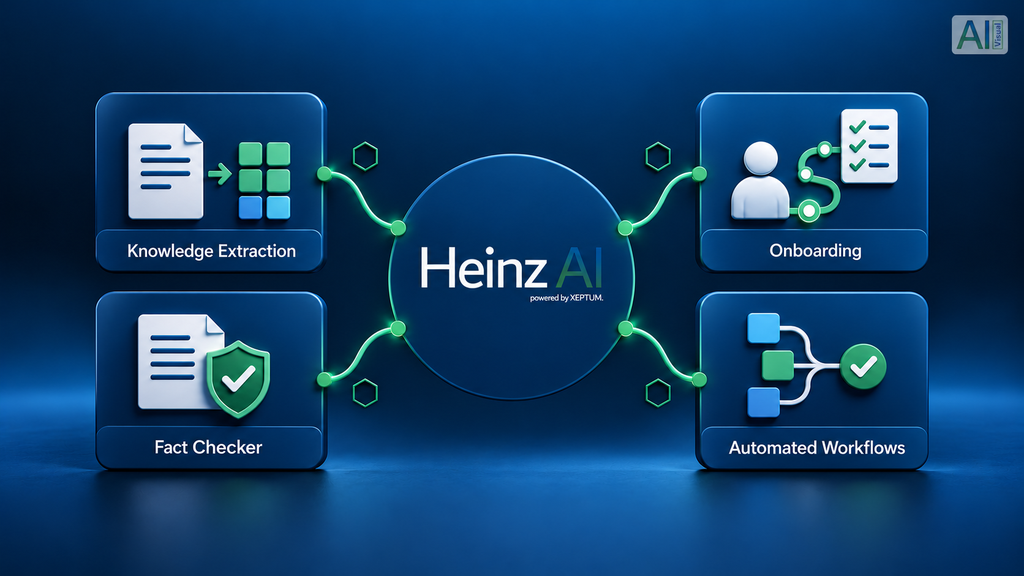
HeinzAI connects specialized skills and supports companies in knowledge-based, automated processes.
Instead of simply formulating an answer, such a workflow can research, evaluate, and consolidate information, and then present it in a format tailored to the individual.
This is precisely what distinguishes “finding information” from “completing tasks.”
Unlike traditional chatbots, agent-based workflows can link multiple steps together and integrate information directly into existing processes. As a result, employees receive not only answers but also support in completing specific tasks.
What capabilities does HeinzAI already offer today?
HeinzAI’s capabilities now extend well beyond traditional knowledge management. The HeinzAI agent-based AI platform creates a modular agent landscape in which specialized agents perform different tasks and are orchestrated by a central assistant. This allows individual capabilities to be combined and applied to specific work processes.
Knowledge Extraction
One of HeinzAI’s most important capabilities is knowledge extraction. Many companies possess a vast amount of experiential knowledge that has never been documented. This knowledge resides in the minds, decisions, and routines of experienced employees. It becomes particularly critical when this knowledge is lost due to employee turnover.
The skill conducts adaptive interviews, analyzes documents, and asks follow-up questions based on previous answers. In doing so, HeinzAI identifies decision-making logic, heuristics, best practices, and empirical insights. The insights gained are converted into structured knowledge modules and made applicable within the corporate context.
This allows for the long-term preservation of knowledge critical to the organization and makes it available to other employees.
Knowledge Test
The knowledge query forms the foundation for many of HeinzAI’s other capabilities. Employees receive answers based on existing corporate knowledge, taking into account the relationships between documents, processes, roles, and systems.
HeinzAI respects existing permissions, provides traceable sources, and can tailor responses to personal preferences. Instead of a traditional document search, it creates an intelligent knowledge dialogue.
Fact Checker
The Fact Checker helps companies ensure the quality of their knowledge base. To do this, HeinzAI compares documents within the knowledge database with one another as well as with external sources.
Contradictions, outdated information, and inconsistencies are identified and presented transparently. This reduces the risk of making decisions based on incorrect or outdated information.
Web Research
Not all relevant knowledge is already available within the company. The web research skill supplements internal information with up-to-date market, technology, and competitive intelligence.
Relevant developments are researched, evaluated, and presented in a structured manner. Combining internal and external knowledge sources creates a more solid foundation for decision-making.
Read SAP Data and Support Processes
HeinzAI enables permission-based access to SAP data and supports defined SAP processes through natural-language interactions.
Employees can retrieve information, search for data, or prepare processes without having to know complex transactions. In collaboration with partners, scenarios are also being developed that enable, for example, forecasting and decision support.
Onboarding
With HeinzAI, new employees receive a digital companion for their first few weeks at the company. The skill answers questions, explains procedures, and points them to relevant documents.
This takes some of the burden off experienced colleagues and allows new employees to get up to speed more quickly. Onboarding is already a key use case for HeinzAI.
Additional specialized skills for everyday work
In addition to these core capabilities, HeinzAI supports other tasks and processes:
- Email Agent: Creates context- and recipient-specific emails that take into account company knowledge and personal preferences. Through a “human-in-the-loop” approach, employees retain the final decision-making authority and can send completed messages directly.
- Employee Directory: Searches skill profiles, roles, and experience to identify suitable contacts and internal experts more quickly.
- Project Management and Team Composition: Analyzes project requirements and takes into account qualifications, experience, and role assignments to suggest suitable project teams.
- Time Tracking: Supports the documentation of work performed based on existing work contexts and integrated calendar, email, or ERP data.
- News Writer: Creates newsletters, company announcements, blog posts, and internal communication content based on existing knowledge sources.
Integration into Existing Systems
To ensure that agent-based AI in the enterprise is not limited to individual applications, HeinzAI can be integrated into existing system landscapes via various interfaces.
- WordPress: Supports the automated creation and publication of content on websites, portals, and knowledge platforms, as well as SEO-optimized and, in the future, GEO-optimized content.
- Jira: Integrates tasks, requirements, project statuses, and documentation into the knowledge and agent landscape.
- SQL Databases: Links structured corporate data with document-based, process-based, and experiential knowledge, enabling analyses and recommendations for action based on this information.
The key added value arises from the interplay of these capabilities. Agent-based AI can combine different skills depending on a task, consolidate information from various sources, and support multi-step workflows. In this way, HeinzAI evolves from a pure knowledge assistant into a platform that specifically integrates corporate knowledge into concrete processes.
Work with our experts to discover which HeinzAI skills support your processes and how existing corporate knowledge can be leveraged effectively.
Discuss HeinzAI’s potential applications now
Why does knowledge management play such an important role here?
Because many AI initiatives fail not because of the models, but because of a lack of knowledge or knowledge that hasn’t been properly prepared.
HeinzAI deliberately distinguishes between fact-based corporate knowledge and personal experiential knowledge. The goal is not only to store knowledge, but also to critically evaluate it, structure it, and make it usable over the long term. Implicit knowledge is particularly valuable in this context, as it is crucial for day-to-day decisions but is rarely documented.
True strength arises when knowledge is no longer confined to documents or individual minds, but is continuously fed back into the business context.
Where is HeinzAI headed?
The long-term vision goes beyond individual assistants.
HeinzAI is evolving from providing factual knowledge via digital assistants to creating digital enterprise twins. These map out role-based logic, knowledge contributions, work processes, and organizational relationships. The goal is a networked agent landscape that actively makes knowledge usable, supports processes, and helps organizations navigate increasing complexity.
One idea remains central to this:
AI is not meant to replace people. It is meant to make knowledge scalable.
To learn about the role AI agents play in the evolution toward the Autonomous Enterprise and why responsibility still lies with humans, read our article “AI Agents in the workplace: people remain in the driver’s seat in the Autonomous Enterprise.”
What can you take away from this for your business?
The key question when using AI isn’t just which model to use. What’s far more important is determining which corporate knowledge should be preserved, made accessible, and utilized for specific tasks.
This is exactly where HeinzAI comes in. By combining knowledge extraction, agent-based workflows, and specialized domain agents, a digital representation of knowledge, processes, and collaboration is gradually created. This ensures that valuable experiential knowledge remains available even when employees leave the company or organizational structures change.
After all, the most successful companies of the future won’t be the ones that use the most AI models, but those that are best able to translate their knowledge into value creation.
Would you like to find out what an initial HeinzAI use case might look like in your company? Then let’s talk together about your knowledge challenges.
Get in touch now with no obligation


