

The shortage of skilled workers remains a challenge for the German economy. At the same time, demographic change poses another problem for many companies: the loss of knowledge due to employee turnover. When experienced workers retire, they often take with them years of accumulated expertise and valuable experience. Companies can counteract this through systematic knowledge transfer, consistent digitization, process automation, and outsourcing.
The skills gap remains significant despite the recent decline. According to the latest KOFA 2025 Annual Review , in 2025, approximately 370,000 job openings could not, in theory, be filled by unemployed workers with the appropriate qualifications. This means that, in theory, one in three job openings for skilled workers remained unfilled.
At the same time, demographic change is increasing the pressure to act. According to recent calculations by the Federal Statistical Office , by 2040, approximately 13.3 million people in the labor force will have exceeded the statutory retirement age. This corresponds to 30 percent of the labor force in 2025.
As the baby boomer generation retires, it leaves behind not only a gap in the workforce but also a potentially significant loss of knowledge. This can pose major challenges for companies, especially in areas where specific technical expertise and experience are crucial.
Do you want to prevent important expertise from leaving the company along with experienced employees?
Contact us now with no obligation
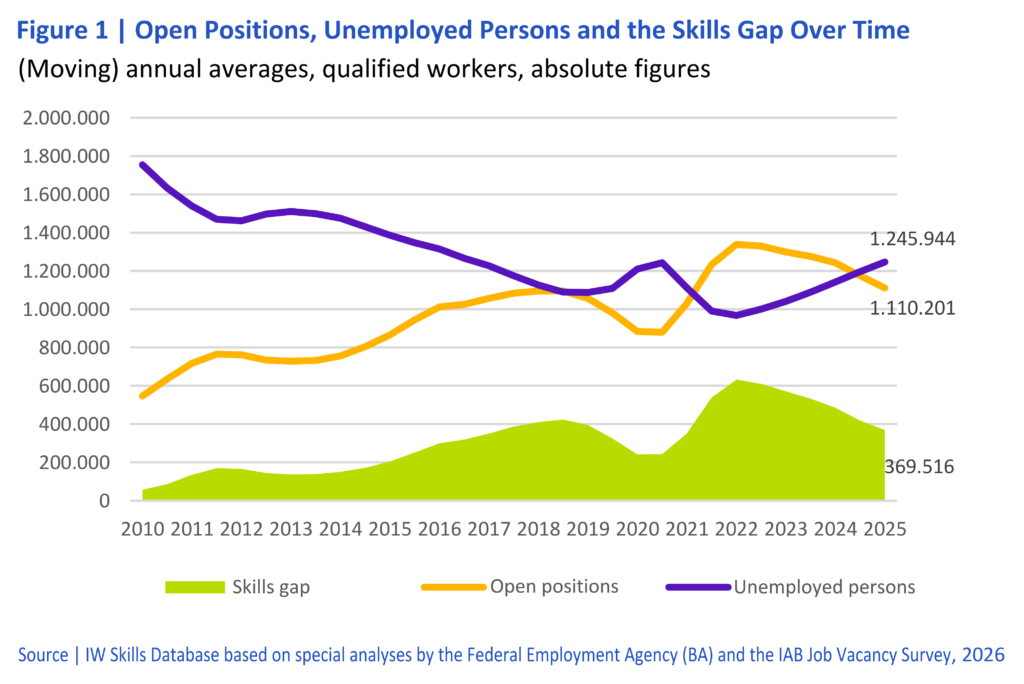
The skilled labor shortage remains high despite the recent decline. In 2025, approximately 370,000 job openings could not be filled by unemployed workers with the appropriate qualifications. Graph: KOFA 2025 Year in Review; Source: IW Skilled Labor Database, 2026.
Why does knowledge loss due to employee turnover become a problem for companies?
Companies have only limited influence over developments in the labor market. This makes it all the more important to respond to the consequences early on. After all, when experienced employees leave, it’s not just a matter of filling open positions. Without a targeted knowledge retention strategy, process knowledge, hard-won experience, and company-specific know-how are also at risk of being lost.
How can companies prevent knowledge loss due to employee turnover?
Companies would be well advised to take matters into their own hands and compensate for the shortage of skilled workers and loss of knowledge through their own initiatives.
On the one hand, a systematic transfer of knowledge is recommended to capture the valuable expertise held by employees in a timely manner and to ensure business continuity. Proven methods include mentoring programs, in which experienced employees pass on their knowledge to younger colleagues, and knowledge databases that store critical information such as process documentation, best practices, and company guidelines.
Another key lever is consistent process digitization and automation of internal business processes. With today’s technologies, it is possible to automate many routine tasks and thereby specifically reduce the workload on skilled employees. This applies not only to areas related to production and shipping but also to commercial and administrative functions.
In addition, AI can be used to preserve the knowledge of experienced employees and make it available to other employees. An agent-based AI platform can help centralize existing knowledge, process it intelligently, and make it available as needed. AI assistants help employees find relevant knowledge more quickly and apply it in their specific work context. This ensures that valuable experiential knowledge remains available even when long-time experts leave the company.
However, for such solutions to be effective, companies must also systematically document their existing knowledge and further develop their processes and IT infrastructure accordingly.
What additional opportunities do shared services and outsourcing offer?
In addition to AI, business process automation (BPA), and other digitalization and automation options, companies can also mitigate staffing shortages through shared services and external services. These include, for example, the management or operation of IT infrastructure and ERP systems. This allows companies to focus their internal resources on new projects and innovations, while specialized service providers handle their day-to-day operations.
Why is change management essential?
To unlock the potential of digitalization, automation, and outsourcing, a company needs a clear strategy and the full support of senior management. Since significant changes to operational processes can always encounter resistance from the workforce, systematic change management – not as a one-time effort, but as a continuous improvement process.
What support does XEPTUM offer in the areas of knowledge preservation and digitalization?
Digitization, automation, and AI help companies preserve valuable knowledge while reducing the workload on their skilled employees. XEPTUM helps identify suitable processes and technologies and establish them sustainably within the company.
These include, for example, digital solutions for knowledge preservation, the automation and optimization of business processes, as well as Application Management Services (AMS).
Find out how XEPTUM can guide you on your journey toward becoming a digitized and future-ready company and engage your workforce in the transformation through targeted change management measures. This allows you to retain valuable expertise within your company, ease the workload on existing skilled employees, and address existing skills shortages in a targeted manner.
Do you want to prevent knowledge loss due to employee turnover and safeguard valuable expertise for the long term?
Contact our experts and schedule a no-obligation consultation.


