

Why intelligent dialogue is more important than traditional documentation – and how companies can permanently preserve experiential knowledge.
Why do companies often lose the very knowledge that gives them their greatest competitive advantage?
The problem isn’t a lack of documentation. What’s far more crucial is that experienced employees draw on knowledge every day that they themselves can barely describe consciously. This tacit knowledge arises from experience, intuition, and context. Modern AI opens up a new approach: Instead of merely managing knowledge, it helps make it visible through intelligent dialogs. This is precisely the approach taken by HeinzAI from XEPTUM with its AI-based knowledge management system, which systematically taps into experiential knowledge.
Why is crucial information often missing despite knowledge management?
Companies invest heavily in knowledge management.
Processes are documented, information is stored centrally, and modern AI systems facilitate access to knowledge. Nevertheless, the same situation often arises: When dealing with complex issues, documentation alone is not enough. Only experienced employees are familiar with exceptions, recognize connections, and make decisions based on years of experience. It is precisely this tacit knowledge that often determines quality, speed, and business success.
Why does traditional documentation reach its limits?
Implicit knowledge is difficult to put into writing.
Many experts cannot fully explain the logic behind their decisions because they have internalized it over the years. Documentation therefore usually describes results or processes – but not the thinking behind them. Much of the most valuable knowledge is gained through action and in specific decision-making situations. That is why, when experienced employees leave the company or retire, it is often precisely those insights that are particularly valuable to the company that are lost.
Find out how HeinzAI taps into experiential knowledge, uses digital assistants, and builds an intelligent corporate memory.
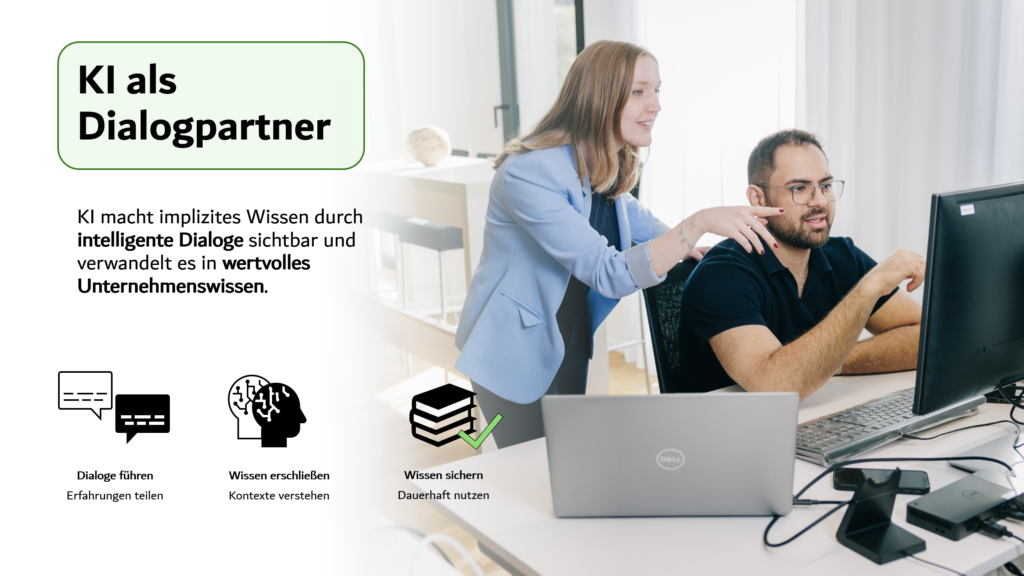
From experiential knowledge to organizational knowledge: AI makes implicit knowledge visible and permanently accessible through intelligent dialogs.
How does AI help make implicit knowledge explicit?
With HeinzAI, XEPTUM is taking exactly this approach.
The key difference lies in no longer seeking to document knowledge exclusively, but rather to uncover it through dialogue. People find it much easier to talk about concrete situations than about abstract processes. They explain why they chose a particular solution, what experiences have shaped them, and what exceptions they take into account. Modern large language models can conduct such dialogs in a targeted manner. They ask follow-up questions, identify connections, and help make decision-making logic visible step by step. This fundamentally changes the role of AI: it not only answers questions but also helps to uncover experiential knowledge that was previously hidden.
Unlocking implicit knowledge is just the first step. Agent-based AI can then use this knowledge to take on tasks and intelligently support workflows. You can learn more about this in our article on agent-based AI.
How does this work in practice?
In a knowledge-intensive company, critical expertise was concentrated among just a few experts.
Although extensive documentation was available, many questions could only be answered with the help of years of experience. Instead of creating additional documents, the experts conducted structured discussions with AI-powered assistants. Through targeted follow-up questions, they created transparent knowledge modules that permanently documented decision-making processes, typical patterns of behavior, and experiential knowledge. As a result, experiential knowledge was no longer tied to individual people but became available to the entire company.
Such structured knowledge dialogs also form the foundation of the HeinzAI platform. They help companies systematically capture experiential knowledge and make it available over the long term.
Why does this change the future of knowledge management?
Knowledge management is increasingly evolving from documentation to active knowledge acquisition.
It is not the amount of stored information that determines a company’s success, but rather the ability to make experiential knowledge permanently available. With HeinzAI, XEPTUM offers a platform for AI-based knowledge management that combines personal digital assistants with intelligent knowledge dialogs. As an SAP Silver Partner, XEPTUM brings extensive experience in complex enterprise and SAP environments to the table. This ensures that tacit knowledge is not only documented but also made permanently available to employees.
Personal digital assistants play a key role in this. To learn how they make corporate knowledge intelligently accessible, check out our article “Personal Digital Assistant Instead of Chatbot.”
Especially in light of demographic change and the shortage of skilled workers, this ability is becoming a decisive competitive advantage.
How much valuable experiential knowledge does your company possess?
What matters isn’t how much information is documented. What matters is whether you can make tacit knowledge permanently accessible to others. Artificial intelligence does not replace experts. Rather, it helps to systematically reveal their decision-making logic and secure precisely this knowledge within the company for the long term.
How can experiential knowledge be made permanently accessible?
Find out in a no-obligation consultation how HeinzAI helps to tap into implicit knowledge through intelligent dialogs, preserve it permanently, and make it available to employees.
Contact us now with no obligation


