
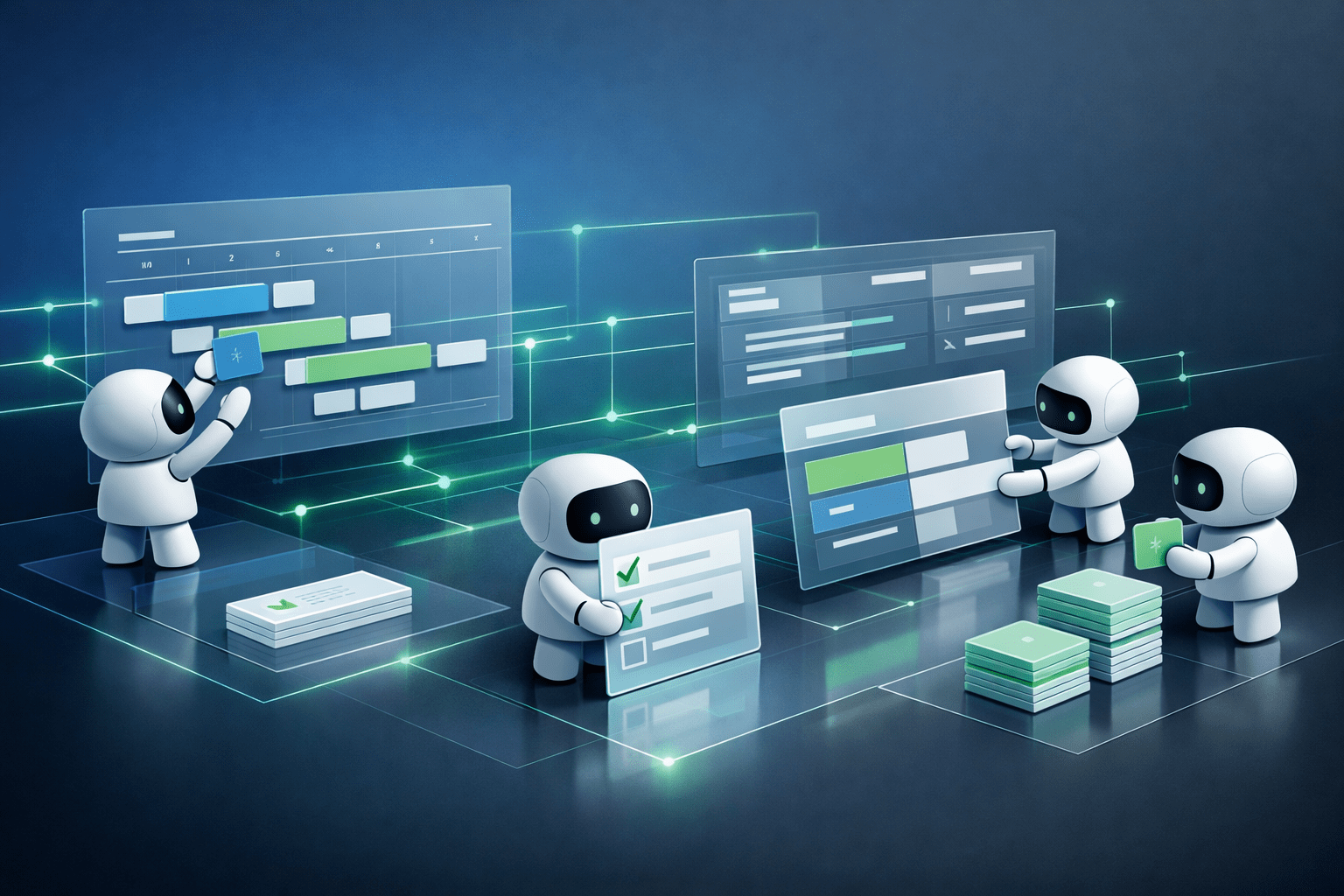
Agent-based AI is fundamentally changing the role of artificial intelligence. While traditional AI systems provide information or answer questions, agent-based systems pursue specific goals and actively assist in the execution of tasks. Today, companies generally lack not the knowledge, but the ability to put that knowledge to use at the right moment. This is precisely where agent-based AI comes in. Companies benefit not only from faster access to knowledge but, above all, from the fact that existing knowledge is directly integrated into processes, decisions, and workflows. The focus thus shifts from finding information to actively carrying out tasks.
Why is AI evolving from providing answers to taking action?
Agent-based AI not only helps answer questions, but also assists with specific tasks.
The first generations of AI systems focused primarily on language processing. Writing text, answering questions, and summarizing content were the typical use cases. However, the role of AI remained largely reactive: an input led to an output.
Agent-based AI fundamentally changes this principle. Modern systems understand not only language, but also goals, tasks, and contexts. They can independently gather information, derive steps to be taken, and prepare decisions within defined parameters.
As a result, AI is evolving from an information tool into an active part of daily work.
Why is searching for knowledge often not the real challenge?
Companies don’t lose time because of a lack of knowledge, but because that knowledge isn’t usable.
In many organizations, the necessary knowledge has long been available. It can be found in documents, specialized applications, databases, or in the employees’ practical experience. Nevertheless, teams spend valuable time every day searching for information.
The real challenge lies in making knowledge available in a way that allows it to be used immediately for tasks and decisions. As long as information is scattered, unstructured, or difficult to access, it leads to inefficiencies, duplication of effort, and unnecessary delays.
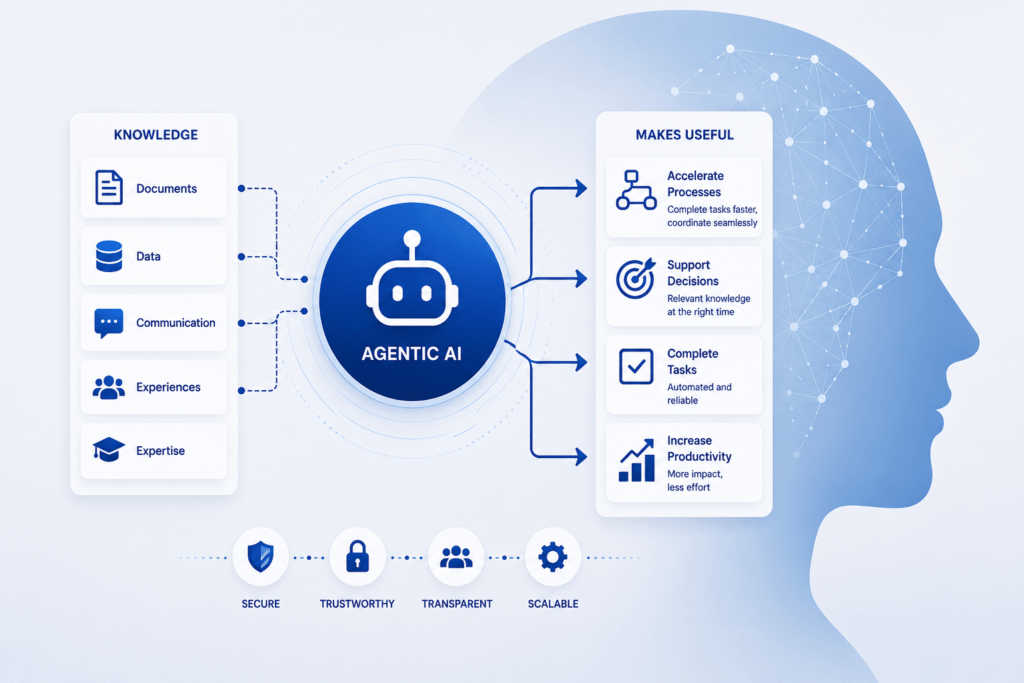
Agent-based AI makes knowledge directly actionable: Information from documents, data, and experience is translated into specific tasks, decisions, and more productive processes.
How does knowledge translate into concrete action?
Knowledge only creates added value when it is directly integrated into work processes.
To achieve this, information from documents, meetings, processes, and other sources must be structured and linked together. Individual pieces of information are transformed into knowledge building blocks, which are organized into interconnected knowledge spaces.
Based on this, agent-based systems can automatically provide relevant information and contextualize it within the respective work context. Employees no longer have to actively search for knowledge; instead, they receive the content they need exactly when it is relevant to their next task.
The real added value comes not from the provision of knowledge, but from its direct applicability.
What are the technical differences between agent-based AI and traditional AI systems?
Agent-based AI combines language models with planning, decision-making logic, and specialized capabilities.
Traditional AI processes an input and generates a response. Agent-based AI, on the other hand, pursues a goal.
To do this, the system breaks down complex tasks into individual steps, evaluates interim results, and independently decides on the next step. In addition, various tools, data sources, or specialized capabilities can be integrated.
This results in a system that not only provides information but also actively participates in task processing.
Why does agent-based AI deliver the greatest value in processes?
The greatest added value is created when process digitization and agent-based AI support or automate recurring tasks.
While traditional AI often answers individual questions, agent-based AI guides users through entire processes. It analyzes information, prepares work steps, and provides context-sensitive support for tasks.
This allows employees to focus more on value-added activities, while routine tasks are handled more efficiently.
This results in significant productivity gains, particularly in areas such as onboarding, project work, knowledge management, support, and decision-making processes.
What does agent-based AI look like in practice?
Onboarding processes clearly demonstrate how knowledge can be translated into concrete support.
A typical example is the onboarding of new employees. In many companies, this process still relies heavily on available contacts, static documentation, and individual experience.
An agent-based system takes a different approach. It analyzes existing skills, considers the requirements of the target role, and automatically identifies knowledge gaps.
This approach enables personalized and dynamic support. Content is prioritized, learning paths are tailored, and relevant information is automatically provided.
This ensures that new employees receive exactly the support they need for their current situation.
Our article on HeinzAI’s Personal Digital Assistant – which provides context-sensitive corporate knowledge and actively supports employees – shows how such an approach can be implemented in practice.
What happens when multiple AI agents work together?
Networked agents can handle complex tasks more efficiently than individual systems.
The true strength of agent-based AI emerges when multiple specialized agents work together. Each agent takes on a clearly defined task and shares its results with the other agents.
For example, information can be researched, analyzed, validated, and processed without having to manually initiate each step.
This results in an intelligent system that not only manages knowledge but also actively uses and further develops it.
What are the benefits for companies?
Agent-based AI reduces friction losses and increases the productivity of knowledge-intensive processes.
Employees spend less time searching for information and can focus more on decision-making and value-added activities.
At the same time, processes are accelerated, knowledge is made available more consistently, and reliance on individual experts is reduced. This results in more efficient workflows and better utilization of the company’s existing knowledge.
Particularly when combined with AI-based knowledge management and a comprehensive digital transformation strategy, this creates an important foundation for sustainable competitiveness.
Why is agent-based AI more than just another tool?
Agent-based AI is evolving from an application to an active support tool within business processes.
The real difference is that AI no longer simply responds to requests, but actively supports tasks. Information is not provided in isolation, but is applied directly within the relevant work context.
This results in systems that integrate knowledge, processes, and tasks and support employees right where decisions are made and results are achieved.
Why does real progress only begin after the answer is given?
The greatest benefit is realized when information is turned into concrete results.
The first generation of AI helped companies access information more quickly. The next generation takes this a decisive step further.
Agent-based AI ensures that knowledge is not only found but also actively utilized. The focus shifts from searching and understanding to providing concrete support for tasks and processes.
In our view, this is precisely where the next stage of AI development in the corporate world lies.
Where can companies start with agent-based AI today?
Knowledge-intensive and recurring processes offer the greatest potential for quick results.
Areas such as onboarding, knowledge management, support, project work, and decision-making processes are particularly well-suited for the use of agent-based AI. In these areas, the necessary knowledge is usually already available but is not yet being used to its full potential.
Agent-based AI helps translate this knowledge into concrete support, thereby sustainably improving productivity, quality, and speed.
Are you wondering which tasks in your company could be supported by agent-based AI? If so, it’s worth taking a look at the processes where, even today, knowledge still needs to be sought out, information shared, or decisions prepared. That’s often where the greatest potential lies for making better use of existing knowledge and streamlining processes.
We’d be happy to work with you to identify the areas where agent-based AI can create the greatest value for your business.


