

The skills shortage is slowing down the German economy – with a rising trend. While companies have already lost 49 billion euros in production potential in 2024 as a result, this figure is expected to rise to 74 billion euros by 2027. This negative trend can only be countered by those who rely on consistent digitization, process automation and outsourcing.
The dramatic losses in production capacity are proven by a new study by the German Economic Institute (IW). The main reason is the growing skills gap. While around 570,000 unfilled positions were registered in Germany in 2023, this number is expected to increase significantly in the coming years, mainly because the baby boomer generation is retiring. According to the Federal Statistical Office, around 12.9 million employed people are expected to be affected by this by 2036 – this corresponds to almost 30 percent of the skilled workers available on the labor market.
The retiring baby boomer generations are not only leaving a gap in the workforce, but also a potentially massive loss of knowledge. This can lead to significant problems in companies, especially in areas where specific specialist know-how and experience are crucial.
Why has the problem of the skills shortage persisted unabated for years?
In fact, the growing skills gap has been the subject of heated debate for years – but those in charge have not really done anything about it. On the contrary. An earlier federal government dismissed the problem of the skills shortage as a “threatening gesture by employers” and even introduced a regulation on early retirement.
At the same time, according to official statistics, almost three million people are registered as unemployed in Germany. In reality, however, there are likely to be many more men and women who are not currently employed. Nevertheless, the state is failing to pave the way to the labor market for a significant proportion of them through a sensible infrastructure, appropriate tax regulations and the principle of ‘support and demand’.
In any case, the focus of the current debates is on the influx of foreign workers, which may not solve the problem, but could alleviate it somewhat. However, even in this area, there has only been press-effective discussion for years and the usual political smokescreens are now being lit to sit out the problems instead of tackling them. In concrete terms, this means that a sustainable immigration regulation is not in sight.
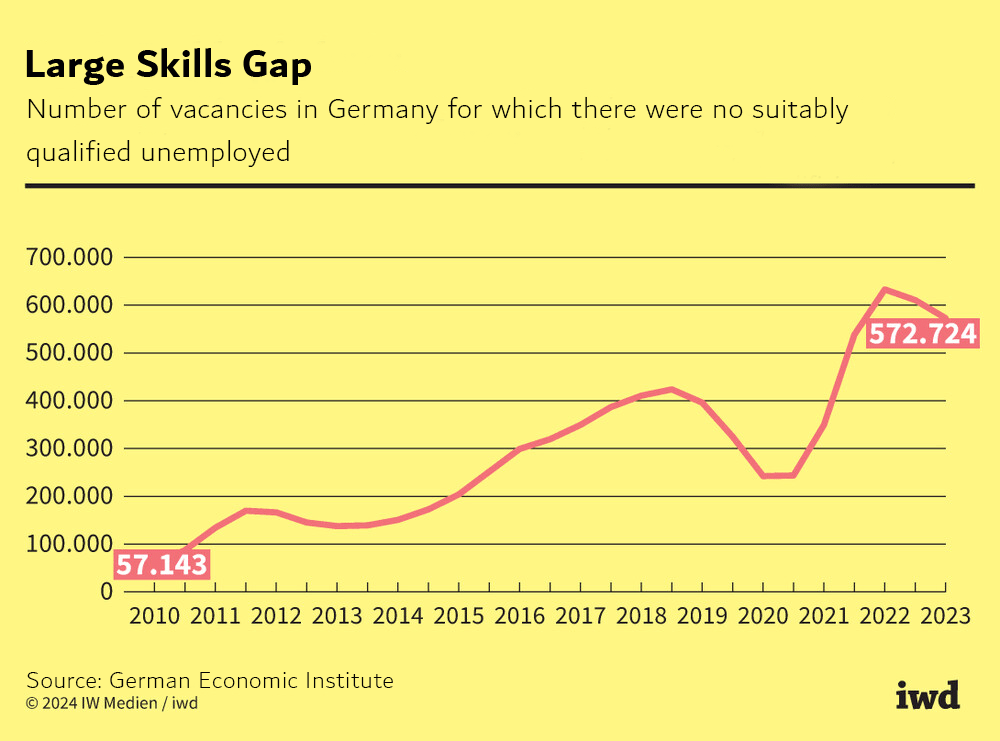
“The skills gap in Germany has increased tenfold since 2010. With digitization and automation, companies can compensate for the skills shortage.” Source: German Economic Institute
How can companies compensate for the skills shortage and loss of know-how?
Companies are therefore well advised to take matters into their own hands – and to compensate for the skills shortage and loss of knowledge, both of which will be further fueled by the upcoming retirement of the baby boomers, through their own efforts.
On the one hand, a systematic transfer of knowledge is recommended in order to secure the valuable expertise in the minds of employees in good time and to maintain operational continuity. Proven methods include mentoring programs, in which experienced employees pass on their knowledge to younger colleagues, and knowledge databases, which store critical information such as process documentation, best practices and company guidelines.
Another central lever is the consistent digitization and automation of internal company processes and procedures. With today’s technologies, it is possible to shift many activities from people to robots, computers and artificial intelligence (AI). This applies not only to production-related and shipping-related areas, but also to commercial and administrative areas. It may sound provocative, but it can be assumed that up to 40 percent of activities in these areas can now be automated – if not in every individual case, then as a general rule. Current studies assume that the use of AI alone enables an automation rate of 30 percent.
AI can also be used to secure the knowledge of experienced employees and make it available to young colleagues. For example, there are special AI tools that automatically create documentation of processes while working on the PC in order to process it intelligently and according to requirements.
Of course, companies cannot achieve all these effects without corresponding advance payments – such as the simplification of processes and the modernization of their IT infrastructure. However, the return on investment (ROI) will be achieved very quickly.
What additional opportunities do shared services and outsourcing offer?
In addition to AI, Business Process Automation (BPA) and other options for digitization and automation, companies have other alternatives to reduce their skills shortage. Additional relief effects can be achieved through the use of shared services or the purchase of external services, such as the support or operation of IT infrastructure and ERP systems. This allows companies to bundle their internal resources for new projects and innovations. Specialized service providers take care of the day-to-day business for them.
Why is accompanying change management essential?
In order to leverage the potential of digitization, automation and outsourcing, a company needs a clear strategy and the full support of management. As significant changes in operational processes always encounter resistance from the workforce, a systematic change management is also required – not as a one-off action, but as a continuous improvement process.
What support does XEPTUM offer you during the transformation?
In times of increasing skills shortages, robots, computers & AI offer unparalleled advantages for your company. These technologies are always available, are not affected by work bans as in the Corona period, do not get sick and do not know overtime.
In this newsletter, we present some attractive application options with which you can save human activities and achieve a high ROI:
- Automation and optimization of logistics invoice verification in SAP
- Relief through SAP Application Management Services (SAP AMS)
- Efficient financial processes through AI and automation
- Test optimization through AI
Find out how XEPTUM can accompany you on your way to a highly automated and future-proof company and prepare your workforce for the transformation with targeted change management measures. This also offers you the opportunity to exploit your full business potential and tap into new market shares in times of dramatically increasing skills shortages.
Contact us and receive more detailed information! Benefit from our comprehensive process and technology know-how at the cutting edge. Together with you, we will develop a consistent digitization and automation strategy and support you in its smooth implementation.

