

Outsourcing logistics processes offers enormous competitive advantages: foremost among them cost savings, flexibility, and rapid market access. Flexible logistics networks with SAP provide an ideal platform for connecting logistics service providers and third-party systems. For efficient integration, SAP-based interface expertise is essential.
Current studies show that outsourcing to specialized logistics service providers is a key growth and success factor for future-oriented companies.
The following facts and figures speak for themselves:
- Cost reductions of 15 to 20 percent: Conversion of fixed into variable logistics costs
- Reduction of time-to-market by up to 45 percent: Rapid access to new regions without proprietary logistics structures and local expertise
- Significantly lower risks upon market entry
- 30 percent faster reactions to regional market changes
- Flexibility in demand fluctuations: Scalable logistics capacities without upfront investments and fixed costs
- Focus on core business: Release of resources for core competencies such as product development and manufacturing
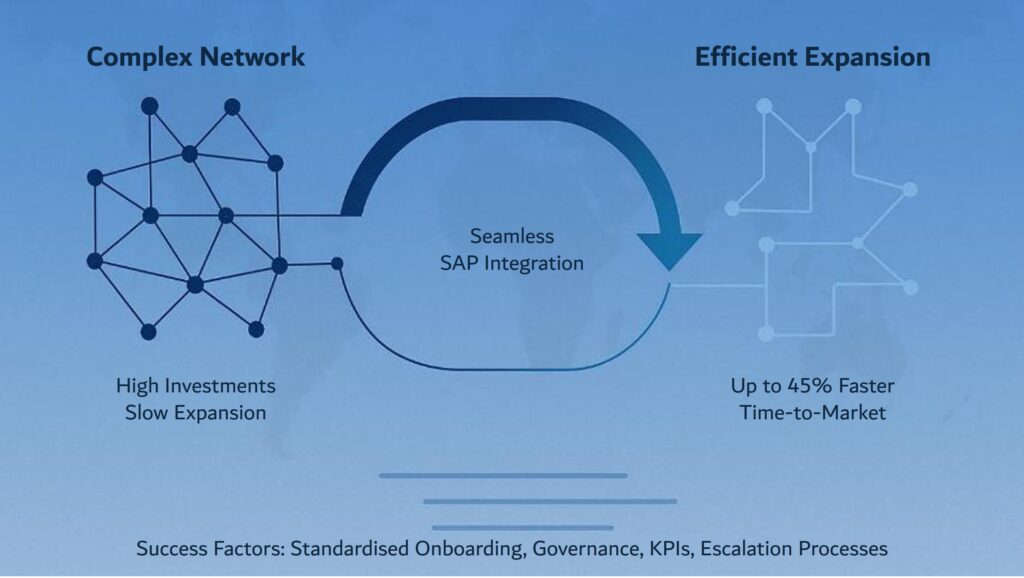
Flexible logistics networks with SAP and SAP EWM can significantly accelerate market expansion
How Do SAP Systems Enable the Seamless Integration of External Logistics Partners?
With SAP systems such as SAP Warehouse Management (SAP WM) or SAP Extended Warehouse Management (SAP EWM), companies have an optimal basis for connecting logistics service providers and third-party systems. Through specialized components for data exchange and process integration, you can build flexible logistics networks with SAP that provide you with complete transparency and control – despite outsourcing.
These SAP components play a key role in integration:
- SAP EDI (Electronic Data Interchange): Standardized exchange of business documents with logistics service providers
- SAP IDoc (Intermediate Document): Structured format for cross-company data exchange
- SAP SCM (Supply Chain Management): Holistic planning and control of all logistics processes
- SAP TM (Transportation Management): Optimization of transport routes and costs across company boundaries
These technological building blocks enable seamless integration, where information flows in real-time between companies and external service providers – as a fundamental prerequisite for efficient logistics networks.
What Challenges Does Connecting Logistics Service Providers to the Existing SAP Infrastructure Pose?
While the technical SAP infrastructure forms the foundation for successful logistics networks, the integration of external logistics service providers presents many companies with challenges. Problems frequently arise, particularly at the interfaces between internal SAP systems and external applications:
- Data Consistency: Different data structures between SAP and non-SAP systems
- Real-time Information: Delayed status messages during goods handover and transport
- Process Breaks: Unclear responsibilities at system boundaries
- Loss of Transparency: Limited end-to-end visibility in the supply chain
To overcome these challenges, experience in dealing with external partners and third-party systems is required, keyword: SAP-based interface expertise. Proven integration concepts and best practices help to avoid typical problems and accelerate integration.
Particularly relevant success factors are:
- Standardized onboarding processes for logistics service providers in SAP
- Established governance structures for cross-company processes
- Defined KPIs for performance measurement of logistics partners
- Proven troubleshooting and escalation paths
These success factors are based on many years of project experience – experts with comprehensive SAP logistics know-how are in demand.
Is SAP-based Interface Expertise Required within your Own Company?
Leverage XEPTUM’s comprehensive expertise in SAP logistics integration to unlock the full potential of your logistics networks.
For this, we recommend the following structured approach:
- SAP Logistics Audit: Evaluation of your current SAP integration and identification of optimization potential
- Outsourcing Strategy: Definition of your ideal logistics partner landscape and interface architecture
- SAP Roadmap: Determination of the required SAP modules and extensions (SCM, TM, EDI)
- Partner Evaluation: Selection of compatible logistics service providers with SAP integration experience
- SAP Integration: Step-by-step implementation of interfaces and processes
- Performance Monitoring: Continuous monitoring and optimization of logistics KPIs
Why should You Arrange a Personal Consultation with XEPTUM Today?
Arrange a personal consultation with us directly and learn how you can reduce your logistics costs while accelerating your market expansion. Based on our many years of experience in logistics and our SAP interface expertise, we systematically support you in seamlessly integrating external logistics service providers into your SAP system landscape. This allows you to fully concentrate on your core business.
Would you like to build flexible logistics networks with SAP or optimize your existing SAP integration? Contact us today for a no-obligation consultation.


