

E-invoices are increasingly becoming the standard worldwide and are required by law in more and more countries. In Germany, too, the pressure to act is mounting: For companies with prior-year revenue exceeding 800,000 euros, the transitional period for issuing e-invoices ends on December 31, 2026. Starting January 1, 2027, they will be required to issue e-invoices for applicable domestic B2B transactions. For many companies, this is an important reason to begin addressing the technical and organizational requirements – as well as suitable solutions – now at the latest. Companies operating internationally face the additional challenge of efficiently integrating different regulatory requirements into their existing invoicing processes.
With SAP Document and Reporting Compliance (SAP DRC), SAP provides a solution that enables companies to create, process, and monitor electronic documents and regulatory filings. This allows e-invoices to be integrated into existing SAP processes and country-specific compliance requirements to be managed centrally.
How does SAP DRC support companies with e-invoicing?
SAP Document and Reporting Compliance helps companies comply with local legal and tax requirements within their SAP system landscape. This includes, among other things, the creation, validation, processing, and transmission of electronic documents.
SAP DRC can be deployed in various SAP system environments – including SAP S/4HANA Cloud, on-premises systems, and certain SAP ERP environments.
In SAP S/4HANA Cloud, the solution is tightly integrated into the system architecture. In on-premises and traditional ERP environments, however, additional integration and configuration efforts may be required.
Electronic documents or reports are generated in the business system and processed further using the appropriate integration components. Communication with government platforms, business partners, or networks can then take place via SAP Document and Reporting Compliance.
Two areas in particular play an important role here:
- The eDocument Cockpit and its associated apps enable the creation, editing, monitoring, and correction of electronic documents.
- SAP Document and Reporting Compliance, Cloud Edition supports technical communication with external platforms, networks, and country-specific recipient systems.

SAP DRC Dashboard for E-Invoicing and Compliance (own representation based on SAP Help, 2024)
What should be considered when implementing SAP DRC?
The technical requirements depend on the specific SAP landscape, the release being used, and the required country-specific and e-invoicing scenarios.
On-premises
In an on-premises environment, the necessary system components, interfaces, and country-specific settings, among other things, must be set up. In addition, the required formats and legal requirements must be configured and updated regularly.
Cloud
In a cloud environment, many technical components are already integrated into the SAP architecture. However, depending on the scenario you choose, you must activate the required services and set up the appropriate integrations.
Particularly for companies operating internationally, it is important to determine – prior to implementation – which countries, formats, transmission methods, and reporting requirements must actually be covered.
Would you like to know how SAP DRC fits into your existing system landscape?
We can help you assess the technical and organizational requirements.
How does SAP DRC process e-invoices?
SAP DRC supports the creation, processing, validation, and transmission of e-invoices within the SAP system landscape.
The process typically begins with an invoice in the SAP system. Based on the source document, an electronic document is generated and converted into the format required for the respective process.
The e-invoice can then be checked for technical and business compliance and sent to the recipient or the appropriate platform via the designated transmission channel. Status information and feedback can subsequently be monitored in the SAP system.
For Germany, SAP supports various electronic invoice formats and transmission processes. These include, among others, XRechnung and ZUGFeRD, as well as communication via networks such as Peppol.
For customer-specific requirements, extension options are also available within the SAP solution.
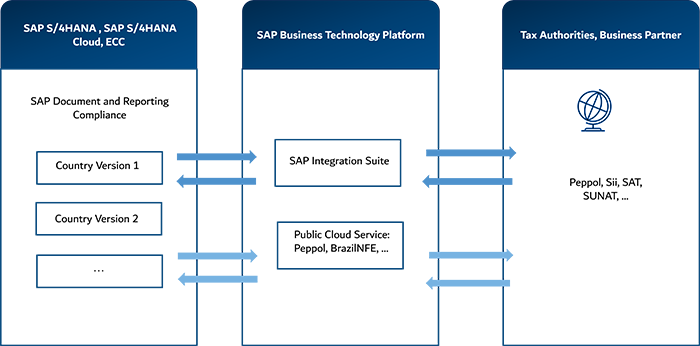
SAP DRC Architecture for E-Invoicing
What challenges does SAP DRC present when it comes to e-invoicing?
SAP DRC offers extensive capabilities for implementing international compliance and e-invoicing requirements. At the same time, companies should also consider the associated effort before implementing the solution.
- Implementation Effort
Depending on the system landscape, countries, and processes, setup may require extensive customization as well as integration and testing efforts.
- Limited flexibility outside of standardized processes
The benefits of SAP DRC are particularly evident within standardized SAP processes. Custom invoicing processes, special logic, or additional non-SAP systems can increase the integration effort.
- Cost-Benefit Ratio
In addition to licensing and usage costs, companies must also factor in the expenses associated with implementation, configuration, integration, and ongoing customizations. Therefore, it is important to assess in advance whether the feature set aligns with the company’s structure and actual needs.
For whom is SAP DRC a worthwhile solution for processing e-invoices?
SAP DRC is not automatically the best solution for every company. Especially for companies that operate primarily within their home country or have a relatively simple system landscape, less complex e-invoicing solutions may also be worth considering.
The following factors are particularly relevant when evaluating SAP DRC:
SAP usage and system landscape:
The more comprehensively the invoicing processes are already integrated and standardized in SAP, the easier it is to integrate SAP DRC into existing workflows.
Volume of e-invoices:
With a high transaction volume, automated processes for creating, processing, and transmitting e-invoices can offer significant efficiency gains.
International scope:
SAP DRC can be particularly beneficial for companies with subsidiaries in multiple countries. This allows for the mapping of different regulatory requirements within a unified solution architecture.
Centralization:
If invoicing processes are consolidated in a shared service center, for example, standardized and automated processes can help reduce errors and speed up processing.
When is SAP DRC a good fit for e-invoices?
Even though there are numerous specialized e-invoicing solutions available on the market, SAP DRC should be included in the evaluation, particularly for existing SAP landscapes.
The key consideration here is not so much which solution offers the most features in general. What matters far more is which architecture aligns with the company’s own system landscape, internationalization strategy, and process structure in the long term.
Companies should therefore assess early on how they intend to handle e-invoices and other electronic reporting requirements in the long term. As part of the process digitization, we help analyze existing workflows, evaluate suitable solutions, and integrate digital processes sustainably into the system landscape.
SAP DRC is therefore not automatically the best solution for every company. However, for companies with high invoice volumes, international structures, and complex compliance requirements, a centralized and integrated solution can offer clear advantages.
Would you like to find out which e-invoicing solution is right for your SAP environment?
XEPTUM is an SAP Silver Partner and has been supporting companies in the further development of their SAP environments for more than 25 years.
Together, we’ll analyze your requirements, evaluate SAP DRC and possible alternatives, and show you how to efficiently integrate e-invoices into your existing processes.
Contact us now with no obligation


