

Margin Analysis in SAP S/4HANA is the modern evolution of classic profitability analysis (CO-PA) and helps companies specifically analyze their profitability: Is money being made with it, and if so, from what? It offers detailed insights into contribution margins, supports strategic decisions, and is tightly integrated into the Universal Journal. But what can the solution really achieve, and where does it reach its limits?
As with its predecessor, this module supports the following questions:
- Is revenue generated?
- Which product?
- Which market segments yield a high contribution margin?
- For which product is too much contribution margin left on the table?
Additionally, the module can assist with resource bottleneck decisions when it comes to deciding which product or division to focus on. Similarly, it can help determine whether an additional order should be accepted, even if it doesn’t cover all costs.
What can Margin Analysis do?
Margin Analysis in SAP S/4HANA is an evolution of accounting-based profitability analysis and offers comprehensive possibilities for analyzing contribution margins. It integrates seamlessly into the Universal Journal and enables detailed evaluation by market segments, such as customers or products.
- Integration and Real-time Capability: Through its integration into the Universal Journal, Margin Analysis provides a consistent and reconcilable data basis.
- Enhanced Reporting Capabilities: With SAP Fiori, extensive and flexible reports can be created, enabling in-depth analysis.
- Innovative Functions: New functionalities such as Predictive Accounting expand the possibilities of profitability analysis and offer additional insights into future developments.
Where does Margin Analysis reach its limits?
The crucial question is: What potential pitfalls should be considered?
- Complexity: The implementation and use of Margin Analysis can be complex and requires thorough training and adaptation of existing processes.
- Costs: The introduction and maintenance of Margin Analysis can be associated with significant costs, especially if additional modules or customizations are required. However, with a good implementation, the ROI can be high.
- No further development of costing-based profitability analysis: Companies that have previously worked with costing-based profitability analysis will need to make adjustments to certain processes and question established ways of thinking in some areas.
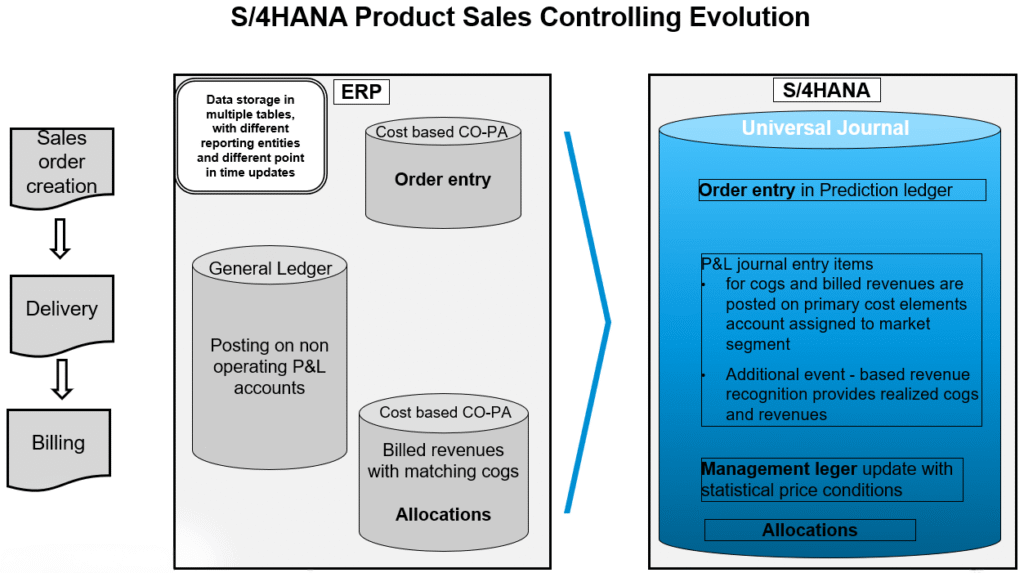
Margin Analysis in SAP S/4HANA (Source: SAP SE)
Why does it make sense to switch to Margin Analysis now?
By now, your company should be in the process of transitioning to SAP S/4HANA. And keep the corresponding requirements in mind to set the course early for a successful introduction of Margin Analysis.
Have you already completed the transition to SAP S/4HANA? Even better! Then the new “look and feel” is familiar to you. You can now focus on implementing Margin Analysis and soon benefit from the new possibilities.
How can XEPTUM help?
As a controller or decision-maker in the company, you know that a company can only be as good as its established processes. Implementing Margin Analysis without considering processes is not only negligent but also highly risky. At XEPTUM, we optimize business processes at the highest level. This ensures that relevant and meaningful figures are included in the Margin Analysis. Contact us today!


